Method for Non-Destructive Separation of a Brazed Joint
Technology Readiness Level
Simple SummaryContent extracted from patent full text and abstract with AI.
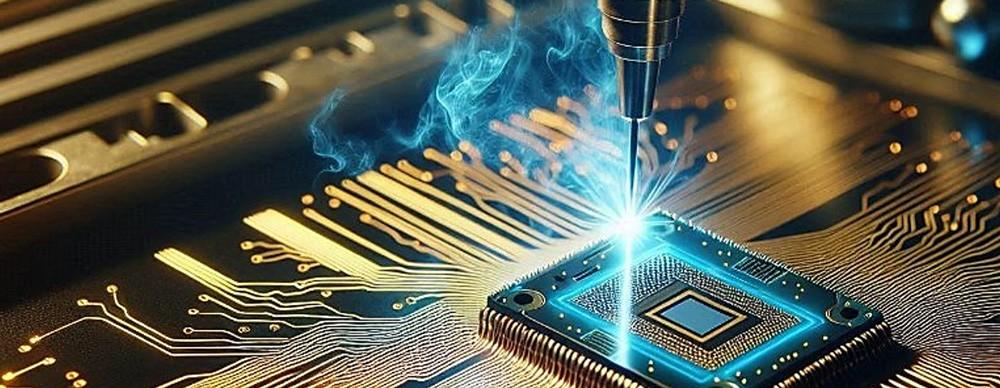
This invention is a method for non-destructively separating soldered joints between two or more metal components. A laser beam is focused on the soldered joint with a power density precisely calibrated to melt the solder material without melting or damaging the base components themselves. The molten solder is then blown away from the joint area using a directed fluid stream with sufficient kinetic energy to clear the solder. The components are separated either progressively during the process or after the solder is fully removed, and at least one of the recovered components is returned to service or further mechanical processing.
Use CasesContent extracted from patent full text and abstract with AI.
- Disassembling soldered heat exchangers or radiators in the automotive industry so that individual metal parts can be reconditioned and reused.
- Recovering high-value copper or aluminum components from soldered electrical busbars or connectors in power electronics manufacturing.
- Reworking defective soldered assemblies in precision engineering or electronics manufacturing without scrapping the base components.
- Enabling circular-economy workflows in metal fabrication shops and in the electronic industry by returning separated, undamaged components to the production cycle.
BenefitsContent extracted from patent full text and abstract with AI.
- The laser power density is controlled to melt only the solder and not the base materials, preserving the structural and surface integrity of both components.
- Fluid-stream removal of molten solder eliminates the need for mechanical cutting or grinding, preventing damage to component surfaces.
- Components recovered by this method can be directly reused or mechanically reworked, reducing material waste and raw-material costs.
- The process supports a closed-loop manufacturing cycle, contributing to circular-economy and sustainability goals.
- Continuous or post-process separation modes provide flexibility to accommodate different joint geometries and production line configurations.
- Laser-based precision allows the method to be applied to complex or delicate assemblies where conventional thermal or mechanical de-soldering would cause damage.
- Significantly less thermal impact on electronic components compared to established technologies, due to localized and focused heat input combined with short process times
Technical Classifications (CPCs)
Main Classifications
Manufacturing & Transport
Sub Classifications
Machine Tools & Metal-Working
CPC Codes
Inventors & Applicants
Inventors
Applicants
Fraunhofer Ges Forschung
Patent Abstract
A method for the non-destructive separation of a soldered joint between at least two metallic components joined by soldering, such that the separated components remain available for subsequent mechanical processing within a circular economy process, is disclosed. A laser beam focal spot is directed onto a joining region of the soldered connection with a power density sufficient to melt a solder material while preventing melting of the material of the components. The focal spot is moved along the joining region by a feed motion. The molten solder material is removed from the joining region by means of at least one fluid flow having sufficient kinetic energy to displace the molten solder from the joint area. The components are separated from one another either continuously as the soldered connection is progressively released or only after complete separation of the soldered joint. At least one of the separated components is subsequently reused.
Key Information
Publication No.
DE102020211378B4
Family ID
77666367
Publication Date
2023-01-26
Application No.
DE102020211378
Application Date
2020-09-10
Priority Date
2020-09-10
Granted
Yes (1/1)
Possible Cooperation
For further information please contact the transfer office.