Electrochemically Debondable Thiol-Catechol-Functionality (TCC) Adhesive System and Use Thereof
Simple SummaryContent extracted from patent full text and abstract with AI.
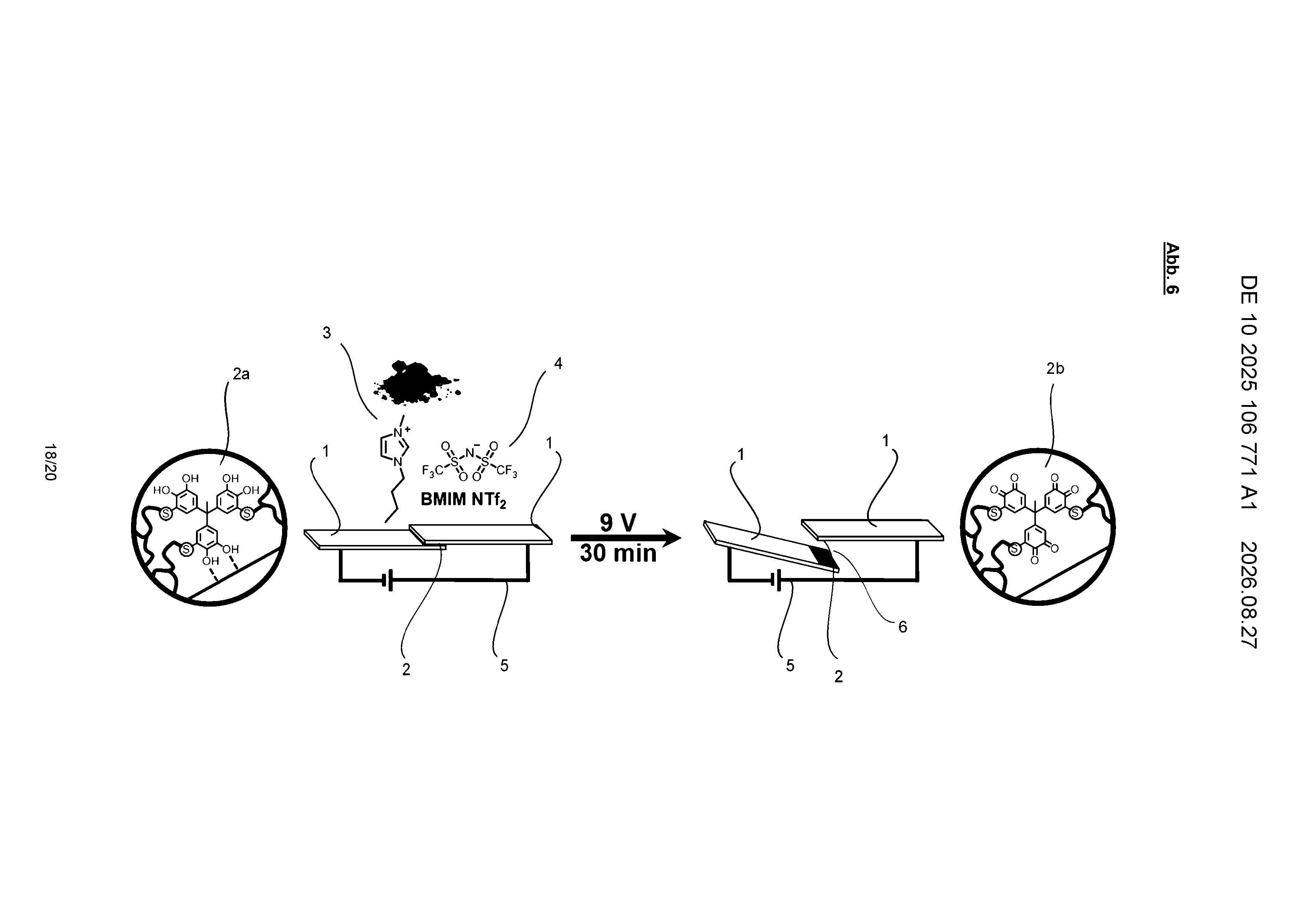
This invention is an adhesive system that can be switched off on demand using an electrical signal. It is based on a chemical combination of thiol and catechol groups that bond strongly when cured, but lose their adhesion when an electric current oxidizes the catechol molecules into quinones. To make this electrochemical debonding practical, the adhesive contains conductive particle fillers and an ionic liquid, which together allow electricity to flow through the adhesive and trigger a controlled release — either fully detaching the bond or simply reducing its strength enough to allow separation.
Use CasesContent extracted from patent full text and abstract with AI.
- Reversible bonding of electronic components (e.g., chips, sensors) to circuit boards, enabling non-destructive disassembly for repair or recycling.
- Automotive assembly lines where body panels or interior components need to be temporarily bonded and later removed cleanly without mechanical damage.
- Medical device manufacturing where implantable or wearable devices must be securely bonded during use but safely detached for replacement or retrieval.
- Consumer electronics (smartphones, tablets) where adhesive joints between screens and housings can be electrically released to facilitate modular repair and end-of-life recycling.
- Aerospace maintenance applications where structural adhesive bonds need to be released on command without heat, solvents, or mechanical force that could damage sensitive substrates.
BenefitsContent extracted from patent full text and abstract with AI.
- Enables precise, on-demand debonding without the need for heat, solvents, or mechanical force, reducing the risk of substrate damage.
- Allows tunable debonding response — either full adhesion loss or partial strength reduction — giving engineers flexible control over the separation process.
- Incorporation of conductive particle fillers and ionic liquids eliminates the need for external electrodes embedded in the substrate, simplifying system integration.
- Supports circular economy goals by making it straightforward to disassemble bonded assemblies for component reuse or material recycling.
- Maintains strong, reliable adhesion under normal operating conditions, only releasing when an intentional electrochemical signal is applied.
- Offers a cleaner and more environmentally friendly debonding route compared to solvent-based or thermally activated adhesive removal methods.
Additional Information
Case Number HU: HU 2024/06
Technical Classifications (CPCs)
Main Classifications
Chemistry & Materials Science
Sub Classifications
Dyes, Paints & Adhesives
Organic Macromolecular Compounds
CPC Codes
Inventors & Applicants
Applicants
Humboldt Univ zu Berlin Koerperschaft des Oeffentlichen Rechts
Patent Abstract
The invention relates to an electrochemically debondable thiol-catechol-functionality (TCC) adhesive system with adhesive system components that react with one another to form a thiol-catechol-functionality and debonding of the cured adhesive system through oxidation of the catechols to quinones, wherein- the adhesive system comprises additives in the form of at least one conductive particle filler (3) and at least one ionic liquid (4) and- via electrochemical switching (5) a controlled debonding is achievable through:- switching off the adhesive strength of the adhesive system until separation or- reduction of the adhesive strength of the adhesive system until separability.The invention further relates to a use of the adhesive system.
Key Information
Publication No.
DE102025106771A1
Family ID
99056343
Publication Date
2026-08-27
Application No.
DE102025106771
Application Date
2025-02-21
Priority Date
2025-02-21
Granted
Status Unknown
Possible Cooperation
For further information please contact the transfer office.