Method and Arrangement for Generating and Processing Photon Streams
 AI
AITechnology Readiness Level
Simple SummaryContent extracted with AI.
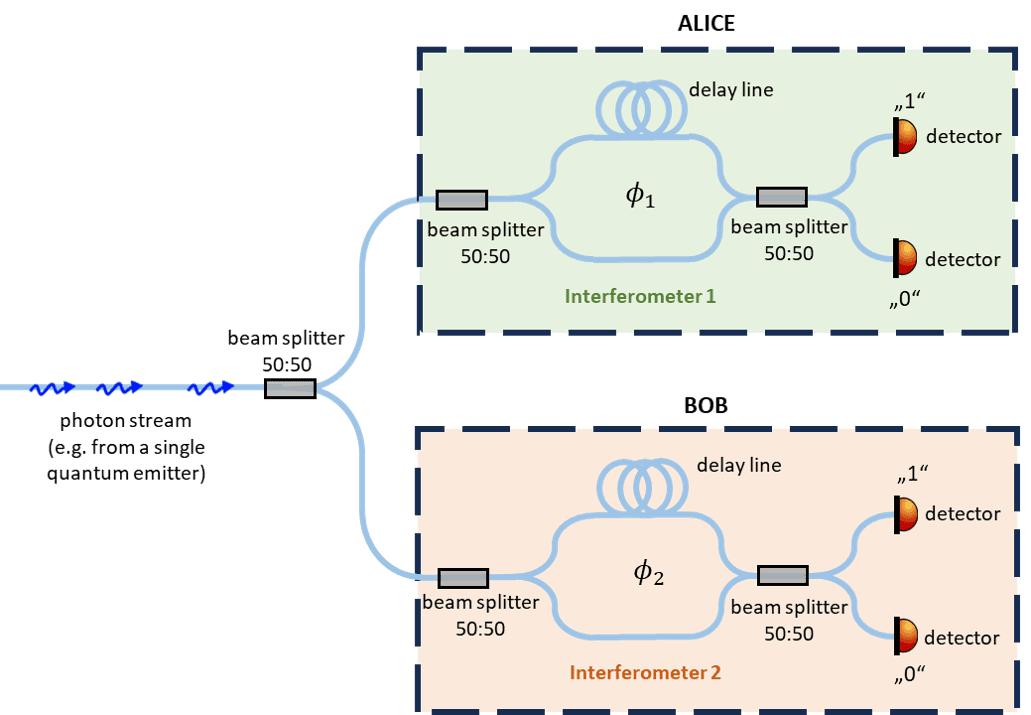
This invention describes a method and system for generating and processing streams of single photons for quantum communication. Each photon in the stream is coherently split into two components that are sent to two separate receivers, where each component generates two time-shifted quantum states. The key innovation is the use of an "anti-bunched" photon stream — one in which photons are spaced apart in time in a highly regular, non-random way — characterized by an anti-bunching length. A bit of information is registered only when both receivers detect a photon event simultaneously or within a time window no larger than this anti-bunching length, effectively using the quantum statistics of the light source as a security and synchronization mechanism.
Use CasesContent extracted with AI.
- Quantum key distribution (QKD) systems where single-photon sources replace weak laser pulses to improve security against photon-number-splitting attacks.
- Secure fiber-optic or free-space quantum communication links between two parties requiring guaranteed single-photon transmission.
- Quantum random number generation systems that exploit the anti-bunching statistics of single-photon emitters.
- Laboratory quantum optics experiments requiring precise coincidence detection between two spatially separated single-photon detectors.
- Development of quantum network nodes where coherent photon splitting and time-bin encoding are used to entangle remote qubits.
BenefitsContent extracted with AI.
- Using an anti-bunched single-photon stream eliminates multi-photon pulses, closing the photon-number-splitting security loophole present in attenuated laser-based QKD systems.
- The anti-bunching length defines a physically enforced coincidence window, providing a built-in, source-intrinsic mechanism for filtering out noise and false detection events.
- Coherent splitting of each photon into two time-bin states at both receivers enables robust time-bin encoding without requiring additional active modulators.
- Coincidence-based bit generation inherently rejects dark counts and stray photons that do not satisfy the tight temporal correlation criterion, improving signal-to-noise ratio.
- The approach is compatible with existing single-photon detector infrastructure (e.g., avalanche photodiodes, superconducting nanowire detectors), lowering the barrier to practical deployment.
Additional Information
Case Number HU: HU 2025/02
Technical Classifications (CPCs)
Main Classifications
Electrical & Electronic Tech
Sub Classifications
Electric Communication Technique
CPC Codes
Inventors & Applicants
Inventors
Arno Rauschenbeutel
Jürgen Volz
Applicants
Humboldt Univ zu Berlin Koerperschaft des Oeffentlichen Rechts
Patent Abstract
The invention relates, among other things, to a method in which a photon stream (P) is generated, each photon of the photon stream (P) is coherently split into two components (K1, K2) of a coherent superposition, the two components (K1, K2) of each photon are respectively transmitted to a first and a second receiver (30, 40), at the two receivers (30, 40) with each component (K1, K2) of each photon respectively two states (Z1, Z2), which each have a predetermined time shift (dT) to one another, are generated, the photons arriving at single photon detectors (120, 130) of the two receivers (30, 40) are detected forming detection information (I) and the detection information (I) of the two receivers (30, 40) are evaluated. According to the invention, it is provided that an antibunched photon stream (P) of coherent photons is generated as the photon stream (P), which is characterized by a temporal antibunching length (ABL), and bit information is respectively generated when the two receivers (30, 40) simultaneously or within a predetermined time window, whose temporal length is at most as large as the antibunching length (ABL) of the antibunched photon stream (P), register a detection event.
Key Information
Publication No.
DE102025107544A1
Family ID
98937694
Publication Date
2026-08-27
Application No.
DE102025107544
Application Date
2025-02-27
Priority Date
2025-02-27
Granted
Status Unknown
Possible Cooperation
For further information please contact the transfer office.